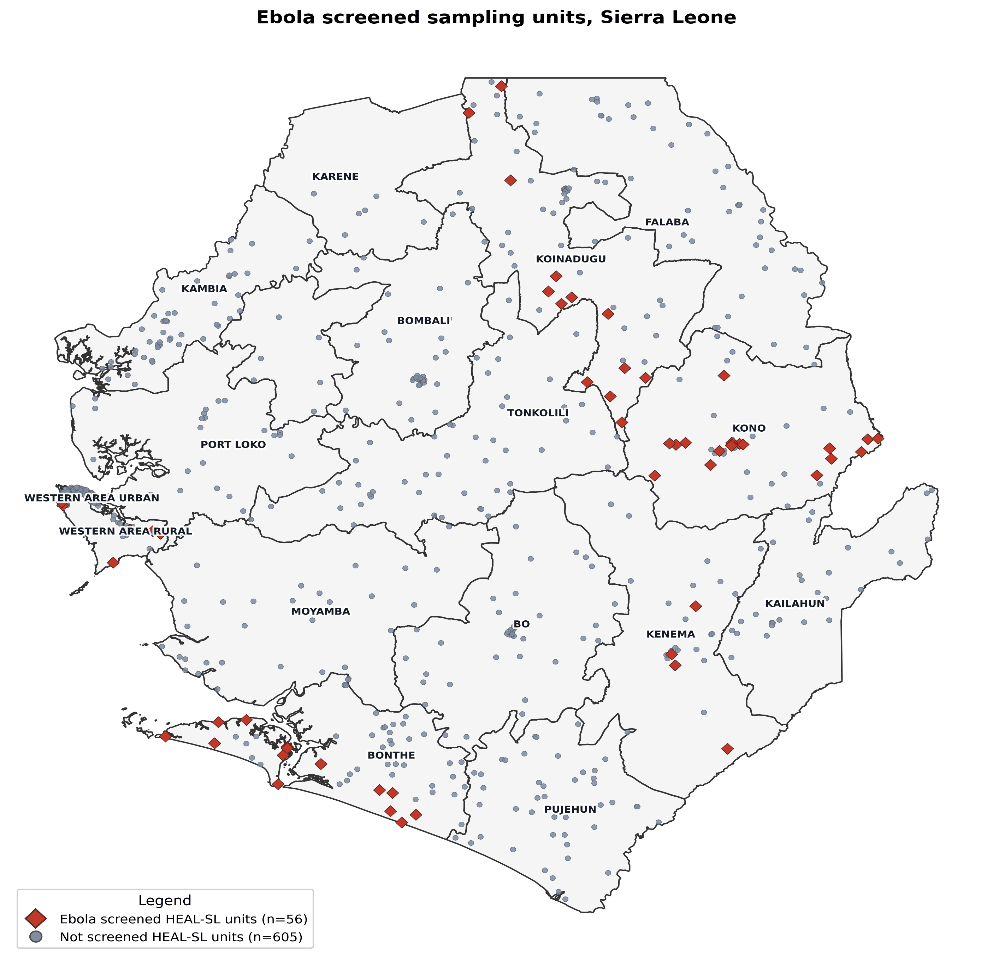
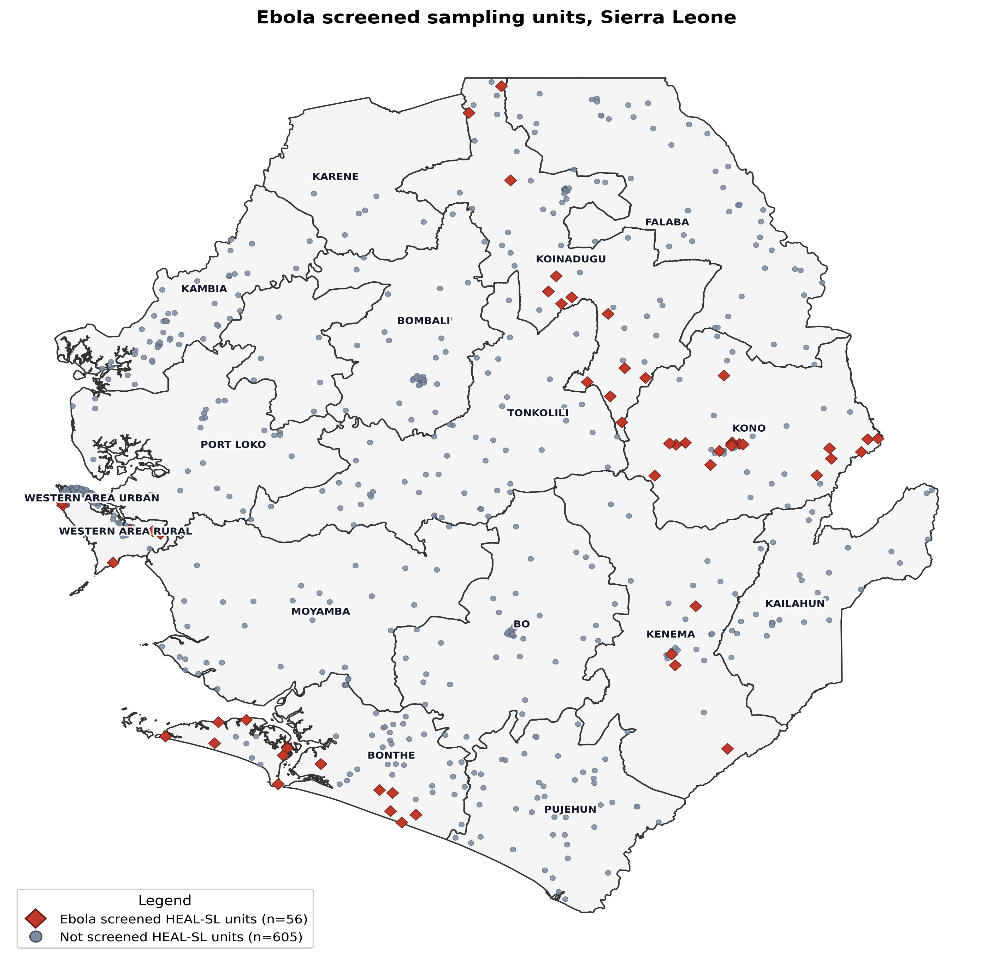
A six-question Ebola symptom screen added to routine HEAL-SL household visits in 56 sampling units across five districts, with symptom levels benchmarked against verbal-autopsy deaths from causes unrelated to Ebola.
Key findings
- 3,887 households screened in 56 sampling units across five districts.
- Fever reported by 2.0% of households and unresolving bleeding by 0.3%.
- No household reported travel from the outbreak countries.
- Two households matched the WHO suspected-case pattern (0.05%).
- Symptom levels fell below those among injury deaths, and far below confirmed Ebola case series. Screening continues.
About this study
Background
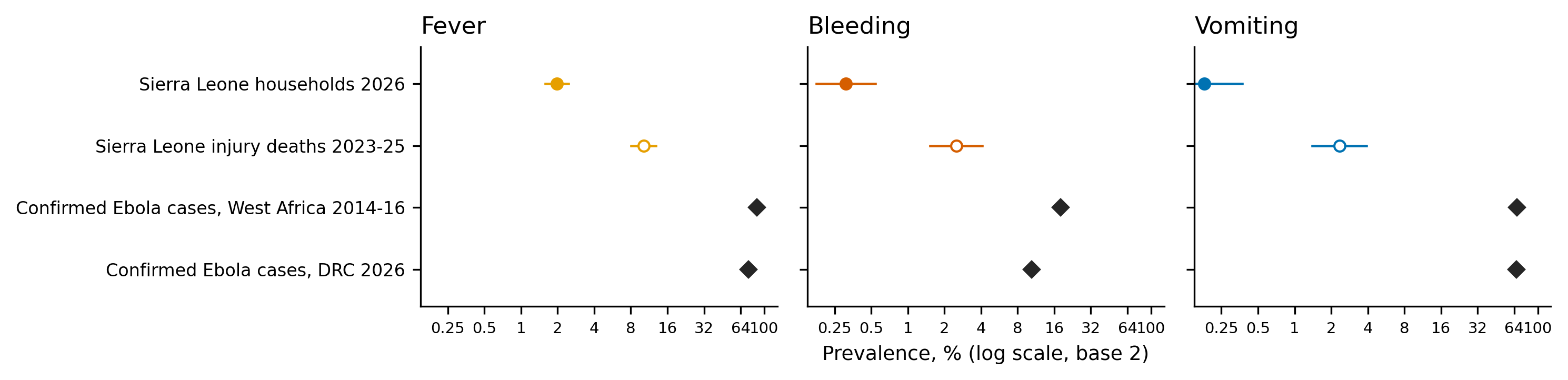
In May 2026, the WHO declared an outbreak of Ebola disease caused by Bundibugyo virus in the Democratic Republic of the Congo and Uganda a public health emergency of international concern. Syndromic surveillance of key symptoms, particularly fever, vomiting and unexplained bleeding, provides a crude but useful profile of whether Ebola cases are occurring. Among the first roughly 4,000 confirmed and probable cases of the 2014-16 West Africa epidemic, fever was recorded in 87%, vomiting in 68% and unexplained bleeding in 18%.
Methods
A descriptive, cross-sectional screen was administered once per household during routine HEAL-SL Round 6 visits, in the sampling units the survey reached between 8 June and 23 August 2026. The instrument was six questions, covering household fever in the past 21 days (with a symptom checklist if yes), unresolving bleeding, international travel in the past 21 days, sudden death after fever, bleeding or vomiting in the past four weeks, and, from mid-June, the respondent's funeral attendance in the past two weeks.
One respondent answered for each household. The form does not record the age or identity of affected persons, and the objective was not case detection: the screening collected data during routine visits and did not include referral or follow-up of households reporting symptoms.
Results
HEAL-SL reached 56 sampling units across five districts, randomly selected villages or small urban blocks drawn from the enumeration areas used in the 2015/6 Sierra Leone Census. A total of 3,887 households were screened, about three quarters of expected households.
Among the households replying, 2.0% (95% CI 1.6-2.5) reported fever in the past 21 days. Very few reported unresolving bleeding (0.3%), sudden death following fever, bleeding or vomiting in the past four weeks (0.5%), or international travel (0.3%). Travel destinations were Liberia and Guinea for five households each, and none from the Ebola outbreak countries.
Two households reported fever alongside three or more listed symptoms, matching the WHO suspected case pattern (0.05%, 95% CI 0.01-0.19%).
Fever, bleeding and vomiting were rarer than among injury deaths recorded in earlier HEAL-SL verbal autopsies (10.2%, 2.5% and 2.3%), and far rarer than in confirmed Ebola case series.
What this means
Across 3,887 households in 56 sampling units in five diverse districts of Sierra Leone, reports of the symptoms that would signal Ebola were uncommon. Ebola related symptoms are therefore uncommon in Sierra Leone, and a national surveillance platform can answer a rapid syndromic question within weeks.
Limitations
For speed, answers were recorded only at household level: the affected person's age and identity were not recorded, so results cannot be age-stratified. The funeral question lacks answers for 20% of households. Collection ran 8-15 June and 8-23 August with 21-day and four-week recall windows, so events from mid-June to mid-July fall outside every window. The results do not represent the whole country, but do cover the key areas of mobility expected if there were imported Ebola cases from Guinea and Liberia.
Outputs
- In reviewReport · September 2026
Household Ebola symptom prevalence from June–August 2026 within the HEAL-SL mortality-surveillance platform
Submitted to the National Public Health Agency of Sierra Leone.
- In preparationComment
Journal Comment on the Ebola symptom screening
A link will be added here once it is published.
Files
Related links
Study team
Partners
- National Public Health Agency of Sierra Leone
- Njala University
- University of Toronto
- University of Oxford
Study leads
- Prof Rashid Ansumana — Njala University
- Prof Foday Sahr — National Public Health Agency of Sierra Leone
- Prof Prabhat Jha — University of Oxford